There’s a version of an entryway that most people know: a narrow space with a console, a mirror, and something in a vase. Functional. Forgettable. And then there are luxury entryways that actually have a point of view. Rooms that set a tone before you’ve seen anything else.
The design work in luxury entryways is unusual because the space rarely has much room to manoeuvre. You’re working with limited floor area, often a single sightline, and the knowledge that whatever you choose will be the first and last thing guests register. It has to land immediately.
What makes the best luxury entryways work isn’t usually a combination of many things. It’s usually one strong choice that the rest of the space answers to. A piece with enough presence to anchor the room without needing anything else to prop it up.
Below are five approaches to that challenge and the Boca do Lobo pieces that execute each one.

See Also: Statement Furniture: Why It Dominates High End Interior Design

Luxury Entryways Approach 1: Let the Mirror Do the Work
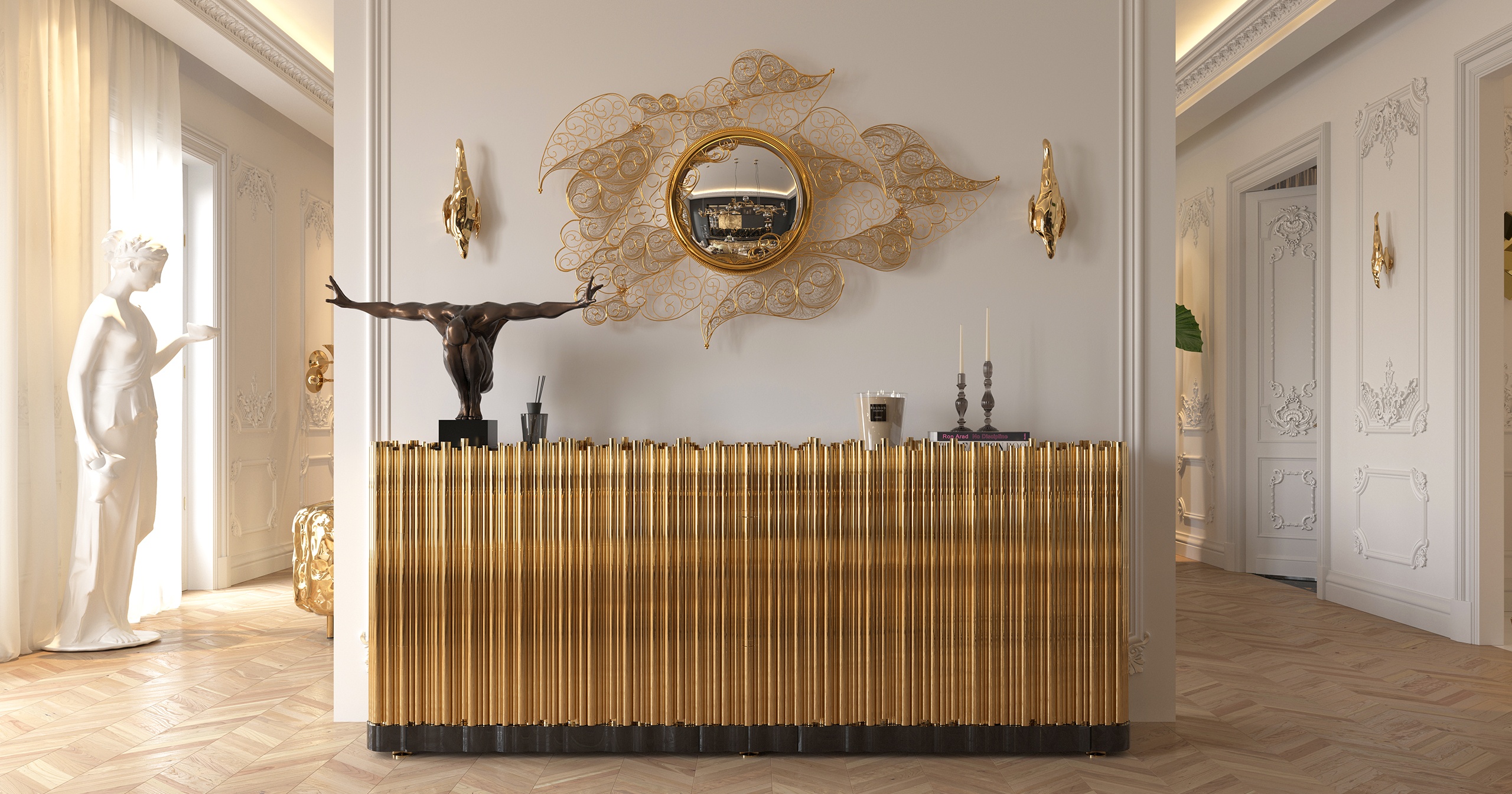
In many luxury entryways, the mirror is treated as a support piece. Something to check your coat in before you leave. The Glance Mirror treats it differently. The radiating frame has a silhouette that reads on a single sightline the way most wall pieces don’t — the shape registers at a glance from across a hallway, which is exactly the condition an entry gives you. You get one look. The Glance uses it.
Hung against a plain wall with nothing beneath it, the piece functions as the room’s entire statement. The mirrors in this category are often underestimated for luxury entryways because people assume the statement has to come from a surface piece like a console or sideboard. The Glance is the argument against that assumption.
It works in luxury entryways with clean architecture and minimal furniture. The frame’s detail gives the room what it needs without requiring anything beneath it. One piece, clear wall space, and the entry is done. Not every space needs more than that.
Publications like Dezeen have documented a growing preference in high-end residential design for single-object entries, where one work-quality piece does more than a composed arrangement of several. The Glance fits that approach better than almost anything else in the category.


Luxury Entryways Approach 2: Start With the Ceiling
Most luxury entryways are designed from the floor up. A console, something on it, a mirror above. That sequence is so familiar it tends to disappear. Starting from the ceiling instead produces a different result entirely.
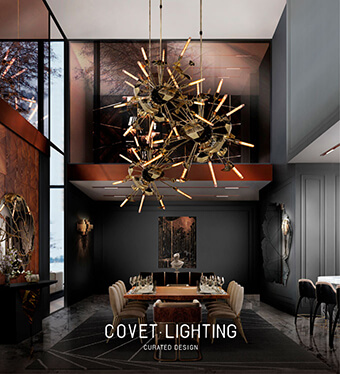
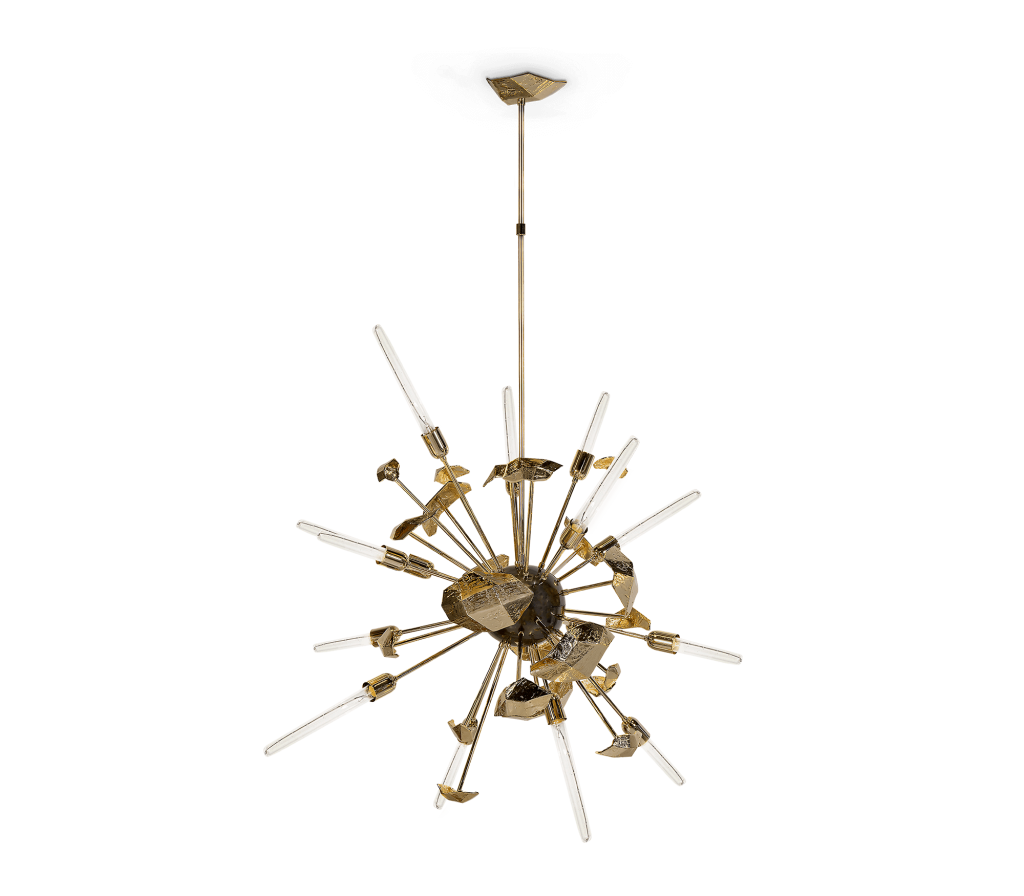
The Supernova Chandelier is the kind of lighting that changes the character of a room before you’ve registered anything else in it. The sculptural brass construction radiates outward like something mid-explosion, and in luxury entryways with double-height ceilings or generous ceiling height, it fills the vertical space in a way that no floor-level piece can match. Guests look up. That’s a rare quality in a hallway.
The Supernova works in entries where the floor-level design is deliberately bare. Stone floor, no console, nothing competing for attention below. The chandelier becomes the entire room. The lighting choice in luxury entryways is also the most visible from the exterior. Before a guest has opened a door, they can read through a window or fanlight what kind of space they’re entering. That’s an unusual opportunity and the Supernova uses it.
According to Architectural Digest, lighting is the most commonly underinvested element in entry design, with most projects concentrating budget on surface furniture. The Supernova Chandelier is the strongest possible case against that habit.

Luxury Entryways Approach 3: Add Vertical Weight
Narrow luxury entryways have a specific problem: there isn’t enough floor area for a wide sideboard to breathe. The instinct is to scale down, find something smaller that fits. The Symphony Cabinet offers a different answer. It’s tall rather than wide. The vertical brass pipes run the full height of the piece, and the arrangement has the slightly irregular rhythm of organ pipes.
In narrow luxury entryways, a vertical piece like the Symphony does something wide pieces can’t: it draws the eye up and makes the space feel taller rather than tighter. The cabinets at the base provide functional storage, which matters in an entry. The brass pipes in front are the design. Together the piece gives a narrow hallway genuine architectural presence without consuming floor area.
Design references from House Beautiful consistently return to vertical emphasis in tight entries as the most effective way to add presence without crowding the space. The Symphony makes that principle feel less like a rule and more like a deliberate choice.


Luxury Entryways Approach 4: Restraint With a Point of View
Not all luxury entryways need to make a loud statement. Some of the most considered entries work through precision rather than scale. A single piece with the right geometry reads more clearly in a narrow space than an arrangement of several things competing for attention.
The Empire Console is this approach done well. The polished brass and dark oxidized base have architectural geometry that gives the piece real visual weight without filling the room. It keeps the hallway passable and the architecture readable. A mirror above, one object on the surface, and the entry is complete.
What separates this kind of restraint from minimalism-by-default is the quality of the piece doing the work. In luxury entryways built on understatement, that single piece has to carry everything. The Empire Console does that. The base detail at floor level gives it something to say even when the surface above is empty. That’s a genuinely useful quality in consoles for entry use, and not many pieces in the category have it.


Luxury Entryways Approach 5: Make No Apologies for the Colour
The most memorable luxury entryways tend to involve a decision that most people wouldn’t make. A colour, a material, a scale that breaks with what’s expected in an entry. The Diamond XL Sideboard in blue is exactly that kind of decision.
The faceted lacquered surface and polished brass detailing are a statement in any finish. In blue, the piece creates a colour note in luxury entryways that carries into the rooms beyond it. Guests remember it. The spaces that follow read differently because of the tone the entry set.
This approach requires some confidence. The Diamond doesn’t ask whether it belongs. Sideboards in this category work best when the rest of the entry answers to them rather than the other way around. Neutral walls, stone floors, minimal overhead lighting, and the Diamond does the rest. It’s a piece for luxury entryways where the goal is to be remembered.
Writers at Elle Decor have noted that high-performing entry designs in contemporary residential projects increasingly lead with one strong colour statement rather than the tonal restraint more common in living spaces. The Diamond Sideboard is the case for that position.

What All Great Luxury Entryways Have in Common
These five approaches look different from each other. One leads with a mirror. One starts at the ceiling. One uses vertical format. One relies on restraint. One bets on colour. What they share is that each one made a call and committed to it.
Luxury entryways that feel designed rather than decorated tend to work this way. A strong single choice, a space that answers to it, and enough confidence not to fill every gap. The pieces that enable that are usually the ones with enough presence to be the room’s reason for being, not just its furnishing.
Browse the full sideboards and consoles collections, or explore mirrors and lighting to see how the same thinking applies across different entry formats. The full living room furniture collection extends many of these approaches into the rooms beyond.
See Also: Sculptural Design: Redefining Luxury Living Spaces